I Walked Off Kona at Mile 11. 41 Days Later, I Won Ultraman.
World Champion
It wasn't a comeback. It was a priority call.
This isn't a comeback story. I didn't bounce back from a bad day. I made a call.
In one of these photos, I'm walking on the Queen K at mile 11 of Kona 2017. The heat is brutal. My body is overheating. I have just realized that I'm not going to be in contention for anything that matters to me at this race. So I stop running and I walk the rest of the way to the finish.
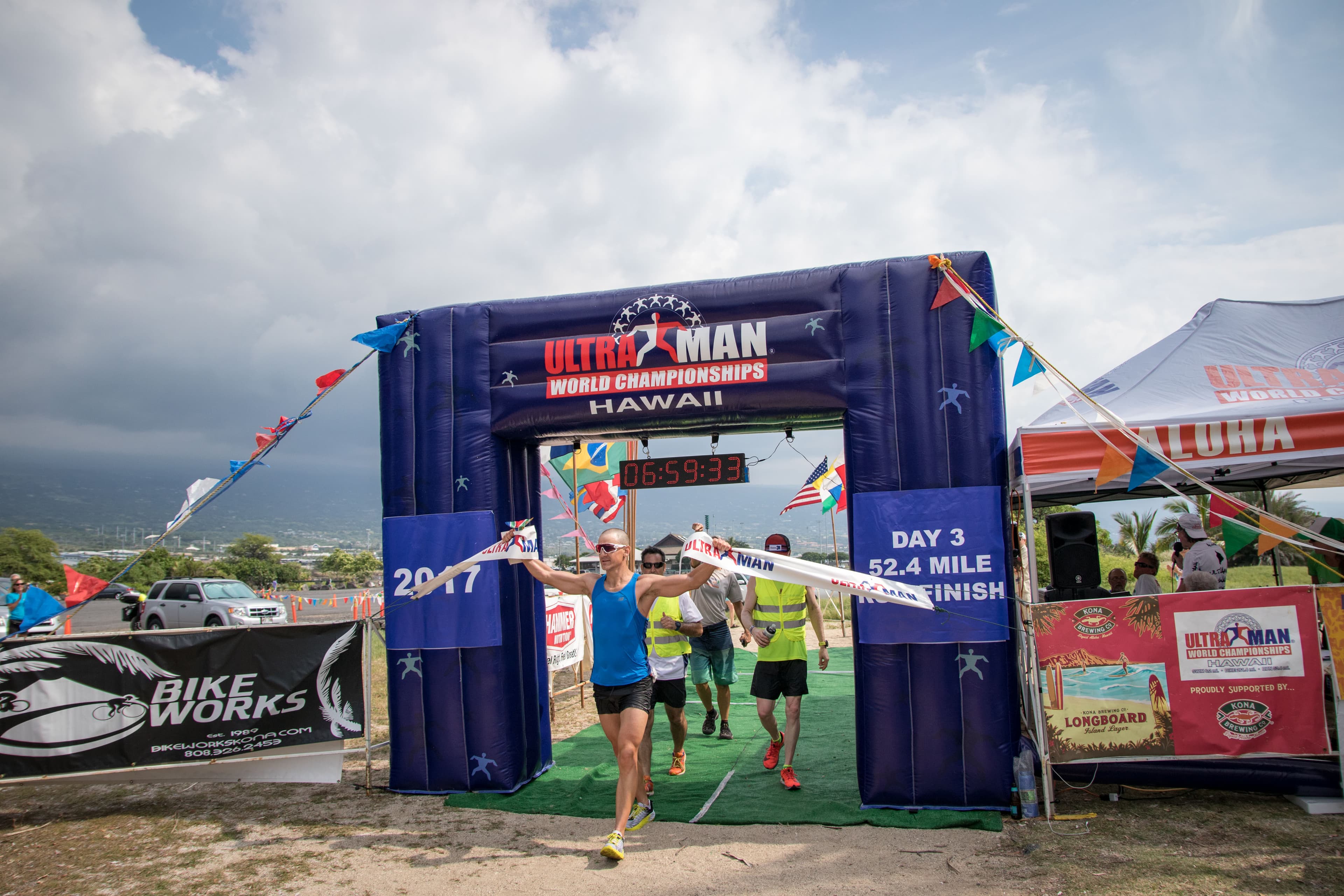
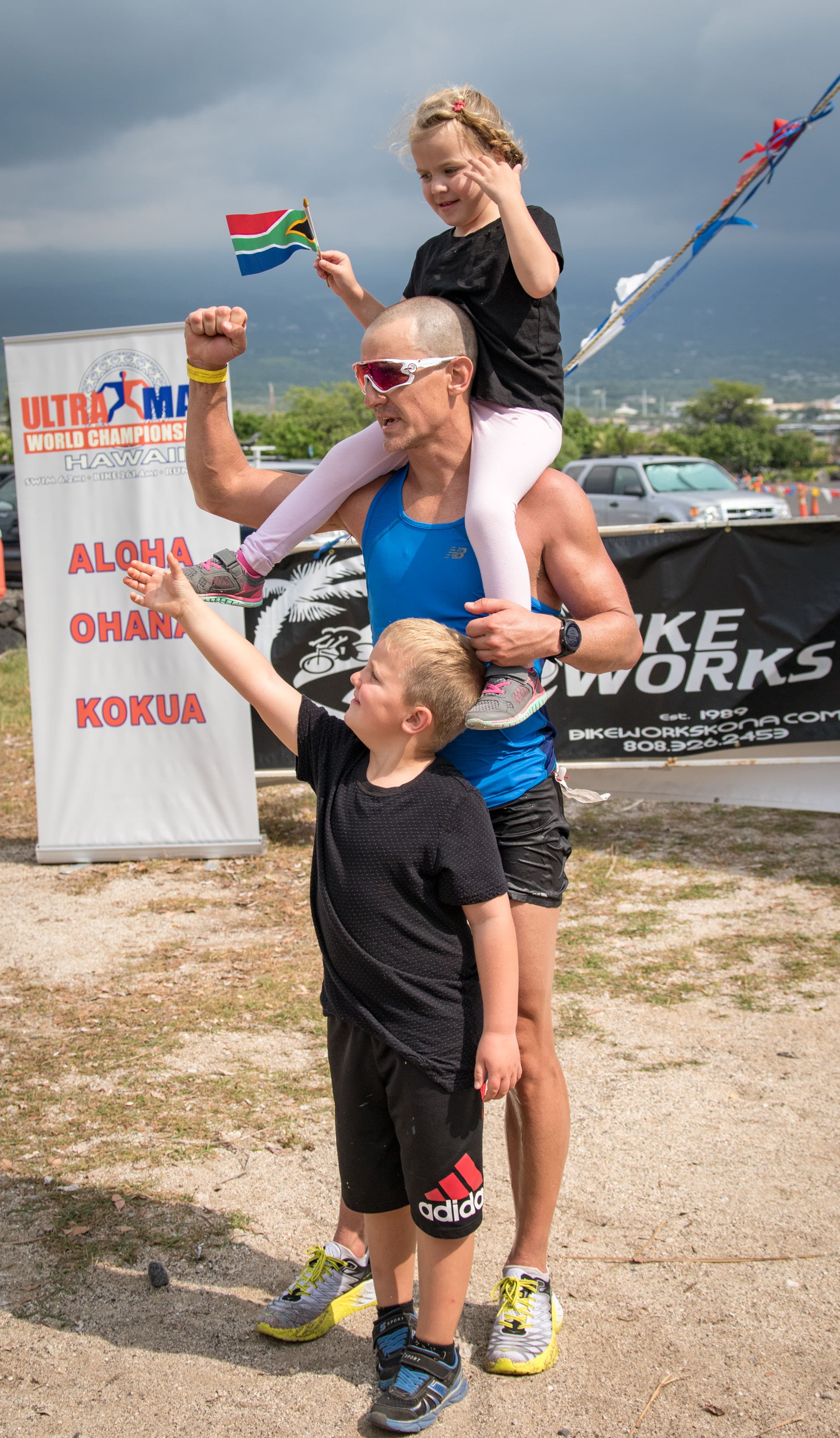
In the other, I'm crossing the line at Ultraman Hawaii 2017. World Champion by 5 minutes over Jeremy Howard, who ran a 6:24 double marathon on Day 3. Which is to say: he ran 7:20 per mile for 52 miles after two days of full-effort racing already. Six-twenty-four. That's not a typo.
These two races happened in the same six-week window. And the reason I want to tell this story is that for years I told it the way most people would: "I had a bad Kona but bounced back at Ultraman. Sometimes that's how it goes." That's the tidy version. The actual version is more interesting and a lot more useful.
The actual version is: I walked off Kona on purpose, because Ultraman was the only race that mattered to me that year and I wasn't going to risk Ultraman to chase an age-group place I didn't care about. Then I trained for 41 days and built Ultraman-specific fitness to its highest point of the year. Then I executed a written race plan with calibrated defense against a runner I knew was going to be faster than me. And I won by exactly the amount the plan was designed to produce.
That's not a comeback. That's a priority call followed by a build followed by an execution.
If you're an endurance athlete who's also running a company, I think you'll recognize the pattern.
Walking off Kona
I'll spare you the full Kona 2017 race report. The relevant facts:
I came into Kona 2017 with a CTL of 139. That's solid. Same band as my Cabo 2013 KQ year, same band as Kona 2014. Not a peak fitness state, but more than enough fitness to race well. I'd done my heat prep: sauna sessions, hot garage rides, midday runs in ski gear. None of it was going to be the difference, but all of it was supposed to add up.
The swim was fine. 1:02. The bike was deliberately controlled: 4:58, 202 watts average power, TSS 253. Not a "burn matches" bike. A patient bike.
The run is where things changed. By mile 6 I was hot. By mile 9 I was past hot. I was overheating in a way I'd felt before, in the same place, at Kona 2015. I could feel my heart beating in my chest. Not racing-hard heart-beating. Heat heart-beating. The kind that says something is wrong with cooling.
Here's the honest part: in the Kona heat, every athlete in the race is looking for an excuse to walk. The brain produces them on demand. "It's hot." "I'm fueling poorly." "The course is unfair." "I'll start running again at the next aid station." The Kona marathon is half running and half an internal negotiation about why you can stop now.
Most of those excuses are bullshit. The brain is just protecting itself from the discomfort. The right move is usually to ignore them and keep running.
What was different at Kona 2017 was that I had legitimate excuses. Several of them.
- I was overheating in a way that felt physiologically dangerous, not just uncomfortable.
- I was not going to win this race. My fitness was solid (CTL 139), but I was not in contention for the result I cared about.
- An age-group place at Kona is not what I'm here for. I've been to Kona enough times. AG placement isn't the goal for me.
- My A-race for the year was Ultraman, six weeks from now. One shot. Six weeks of recovery is not enough to come back from a heat-induced wreck.
- I honestly felt that pushing through this run would be detrimental to my health and to my Ultraman.
So I walked. Not because I gave up. Because I had real reasons, and a clear-eyed view of what mattered most.
"Every athlete in the Kona heat is looking for an excuse to walk. The difference is whether you have legitimate ones."
This is the part of race execution that doesn't get talked about much: race priority hierarchies are real, and they show up before the race even starts. Look at the data:
- Kona race-eve (Oct 13): CTL 139, TSB 4. Essentially a light taper. "Ready enough" but not deeply rested.
- Ultraman race-eve (Nov 23): CTL 153, TSB 32. Deeply fresh, fully peaked.
I'd already been treating Ultraman as the primary race months before Kona. My Kona taper was lighter than my Ultraman taper would be, because protecting Ultraman mattered more than maximally peaking for Kona. So when the heat hit and the body said "stop," it was meeting a brain that had already pre-committed to a priority hierarchy that ranked Ultraman above this race.
I'd argue most amateur racers don't do this enough. They treat every race like an A-race because they paid the entry fee. Then they show up to their actual A-race carrying weeks of compromised recovery from a race that didn't matter. It's a bad trade.
I made the trade in the right direction. I left Kona with a 4:15 marathon walk-time and a body that was ready to recover.
The 41-day pivot
Most people, when they hear "I walked off Kona and won Ultraman six weeks later," assume one of two things. Either Ultraman is somehow easier than Kona (it's not. Three days, 320 miles, and a 52-mile run on Day 3 will disagree with anyone who thinks that), or there was some kind of magical fitness recovery in the gap.
What actually happened was that I built more fitness in those 41 days than most people realize you can build that quickly. And the kind of fitness I built was specifically the kind Ultraman demands.
Here's the data.
Kona race-eve CTL: 139. Ultraman race-eve CTL: 153. Peak CTL nine days before Ultraman: 164.
So I gained 14 CTL points race-eve to race-eve, and 25 points to peak. That's not maintenance. That's a real build.
How real? Eleven days after walking off Kona, I rode a session that produced TSS 437. One of the biggest single-session training loads I've ever recorded. Five hours, 152 km, on tired legs, with TSB still at -62 (the most fatigued point of the entire window). Most coaches would call that aggressive eleven days after walking an Ironman marathon. I called it "the Ultraman bike simulation." Kona wasn't a race I needed to recover from; it was a high-TSS training day that fit into the build.
But the more important thing, and this is where the framework starts mattering, is that the kind of fitness I built was specifically Ultraman fitness. Long aerobic days at controlled effort. The 13.5/1.5 protocol practiced on long runs and bricks. Long bike rides at exactly the pace and effort I'd need on Day 1 and Day 2 of Ultraman. None of it was glamorous. None of it would have been useful for, say, a marathon or a 70.3.
What I actually did in the 41 days
Week 1 after Kona was easy spinning, easy walking, body composition climbing back from race-day depletion. The first ten days I was deliberately letting fatigue clear without pushing.
Weeks 2 through 5 were the build. Specifically:
I trained the 13.5/1.5 protocol: 13.5 minutes running at 8:03/mile pace, 1.5 minutes walking, repeat for 7+ hours. I did it on long runs. I did it on bricks. The goal was to get to Day 3 of Ultraman and have my body so accustomed to that exact pattern that I didn't have to think about it. I wanted muscle memory, not willpower.
I also did what I'd now call CARPE-equivalent sessions: workouts that test whether you can hold race pace under fatigue. Mine for Ultraman were long bricks where I'd ride 4 hours at Ultraman effort and then run the 13.5/1.5 protocol off the bike for an hour or two. The question those sessions answered wasn't "am I fit?" It was "can I hold this exact protocol after this much fatigue?" The answer kept coming back yes.
The most important single session of the build was on November 11, 13 days before race day. I rode 4h 42min, 124 km, with a 60-minute block in the middle at 301W average heart rate 160. That's 97% of my FTP, at altitude (1,700m+), after 65 minutes of prior riding, with a deliberate progressive shape (295W to 305W to 309W across the hour). Zero decoupling inside the effort. This was the binary go/no-go test: at 13 days from race day, can I hold near-FTP for 60 minutes mid-ride at altitude? If yes, the engine is ready. The answer was yes.
By Nov 17, my CTL had climbed to 164. A peak number for me. I was where I needed to be.
That's where the taper began. CTL came down 11 points over the next 7 days as I shed accumulated fatigue. By Nov 23, race-eve, I was at CTL 153 with TSB +32. Deeply fresh. For comparison, my Kona race-eve TSB was 4. Barely tapered. I went into Ultraman with eight times the freshness I'd carried into Kona. Fit enough to win, fresh enough to express it.
The race plan
Let me show you what the written plan looked like.
For Day 3, the double marathon, 52 miles, the plan was:
- Pace target: 8:03/mile average, achieved through the 13.5/1.5 protocol
- Predicted finishing time: roughly 7:00 (52.4 miles at 8:03/mi = 7:01)
- Bike + run combined goal: stay close enough to my main competitor (Jeremy Howard) on the bike days that I can defend on the run
- Decision rules:
- If Jeremy passes me on Day 3, hold pace, don't engage
- If gap closes to under 30 minutes by mile 30, increase pace by 5 sec/mi
- If gap closes to under 15 minutes by mile 40, push to threshold
- If gap stays above 30 minutes through mile 40, hold pace, win on margin
Those decision rules matter. They're the difference between a race plan that survives contact with reality and a race plan that doesn't.
Here's why. Race day, you're going to be fatigued. You're going to be making decisions in a state where your judgment is already compromised. You will not be capable of doing real-time math about whether to increase pace. So the math has to be done beforehand. The decisions have to be pre-rehearsed. When the moment comes, you don't reason. You react to the situation per the plan.
The plan also had specific opponent modeling. Going into Ultraman 2017, I had Jeremy Howard mapped out:
- Strength: incredible runner, capable of sub-7:00 pace for marathon-plus distance
- Weakness vs me: probably 30-40 min slower on the bike based on prior races
- Race plan I expected from him: build the run gradually on Day 3, then push hard from mile 20
Given that, my Day 3 plan was: be exactly fast enough to be unreachable by his best day. Not faster than him in any abstract sense. Fast enough that even if he ran his absolute best, he couldn't quite catch me.
Day 1 and Day 2
The bike days went mostly to plan.
Day 1: 6.2-mile open-water swim, then a 90-mile bike. I swam 2:38:05. Not fast (Jeremy out-swam me by ten minutes), but that was always going to happen. He's a better swimmer than me. The plan didn't depend on me leading after the swim. The plan depended on me out-biking him by enough that his swim advantage disappeared.
The bike is hilly with one long climb where you can either burn matches or be patient. I was patient: 4:51:49 at around 215W normalized. Jeremy rode it in 5:18:54. By the end of Day 1, I'd flipped his 10-minute swim lead into a 16:43 deficit for him. 27 minutes earned on the bike.
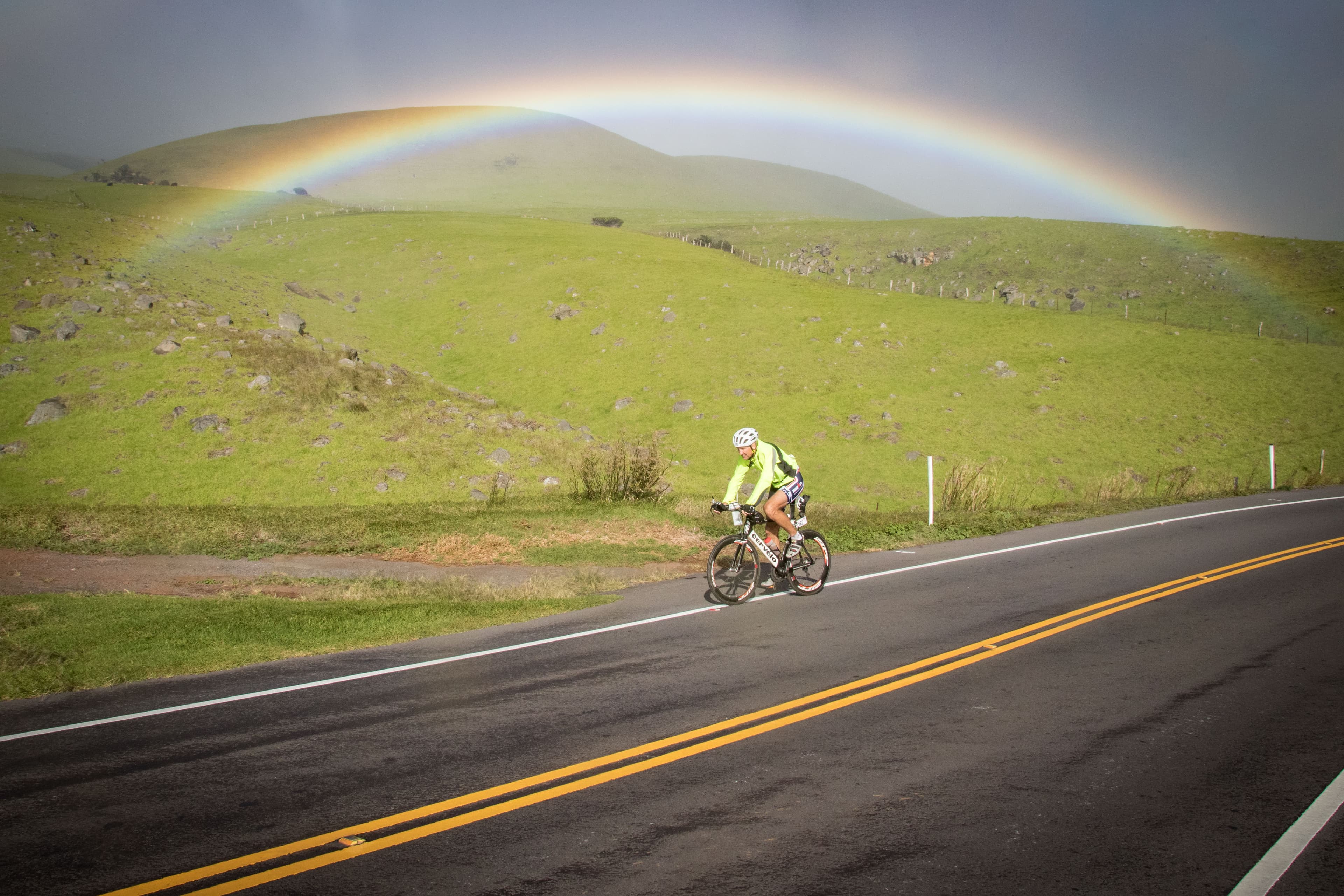
Day 2: 171.4-mile bike. The longest day. I rode 7:50:21 at AP 174W normalized. Not glamorous, but glamorous isn't what wins on Day 3. Jeremy rode 8:14:22. Another 24 minutes for me on the bike.
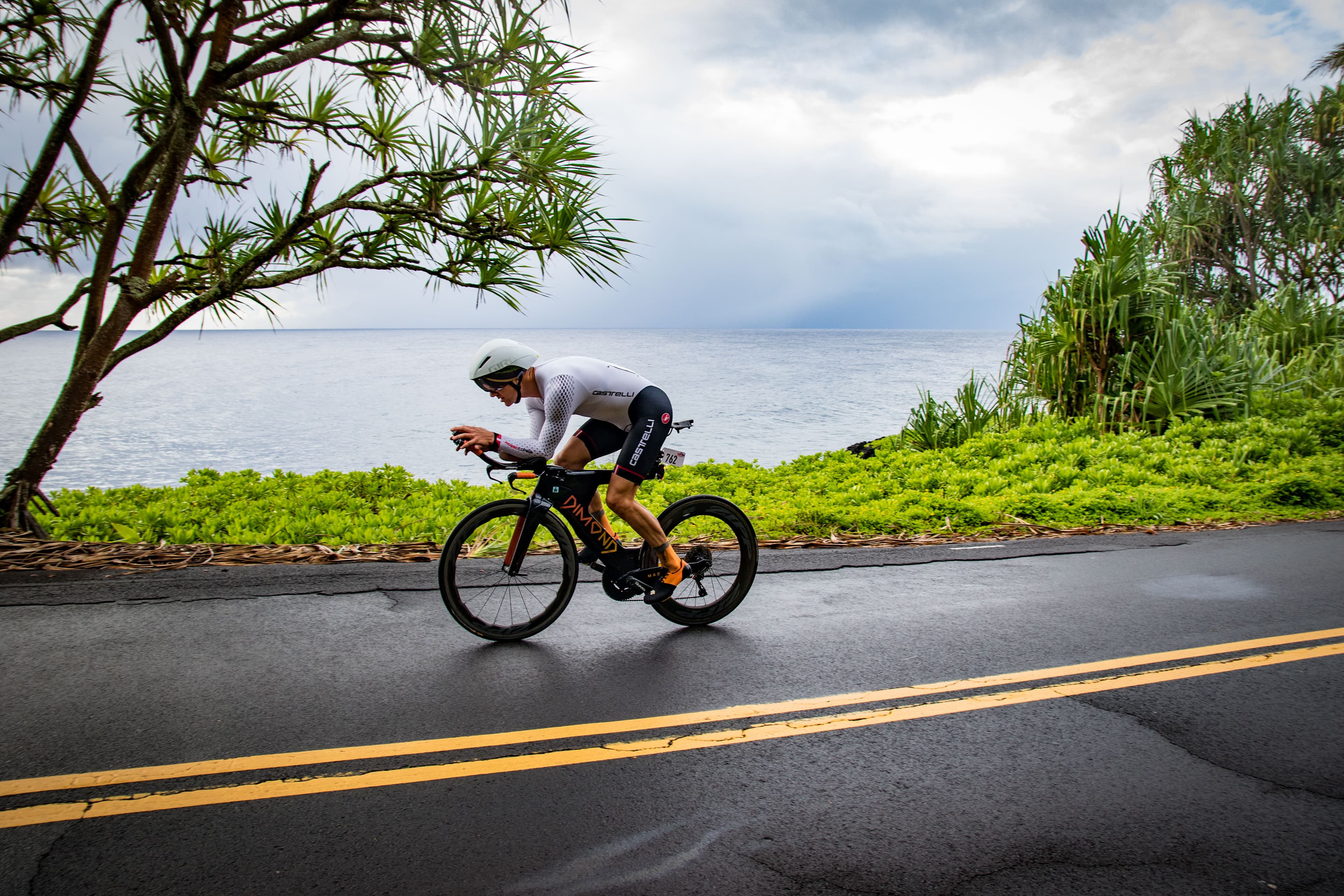
End of Day 2 cumulative: Rob 15:20:15, Jeremy 16:00:59. Lead: 40:44 going into Day 3.
40 minutes and 44 seconds. That sounds like a lot. It is and it isn't. Over a 7-hour Day 3, 40 minutes is roughly 5.7 minutes per hour of margin. If Jeremy ran 5 minutes per hour faster than me on Day 3, he'd close the gap with 30 minutes to spare. If he ran 6 minutes per hour faster, he'd catch me and pass me.
So the question for Day 3 wasn't "do I have a comfortable lead?" The question was: how much faster than 8:03/mi can Jeremy run for 52 miles after two days of racing?
I'd modeled it. My estimate was about 7:30/mi. Maybe 7:20/mi if everything broke right for him. That meant the gap would close, but probably not all the way.
Probably.
Day 3: the actual race
Day 3 of Ultraman starts at 6 a.m. with a 52.4-mile run. Same start line as Day 1 and Day 2; different distance to the finish.
I started exactly on plan. 13.5 running at 8:03/mile. 1.5 walking. Repeat. The 13.5/1.5 was working. I didn't have to think about it because I'd done it so many times in training that my body just executed.
By mile 20 I was holding pace exactly. My average heart rate was 140, exactly my IM-effort signature. The 13.5/1.5 protocol was producing the cardiac state I'd targeted.
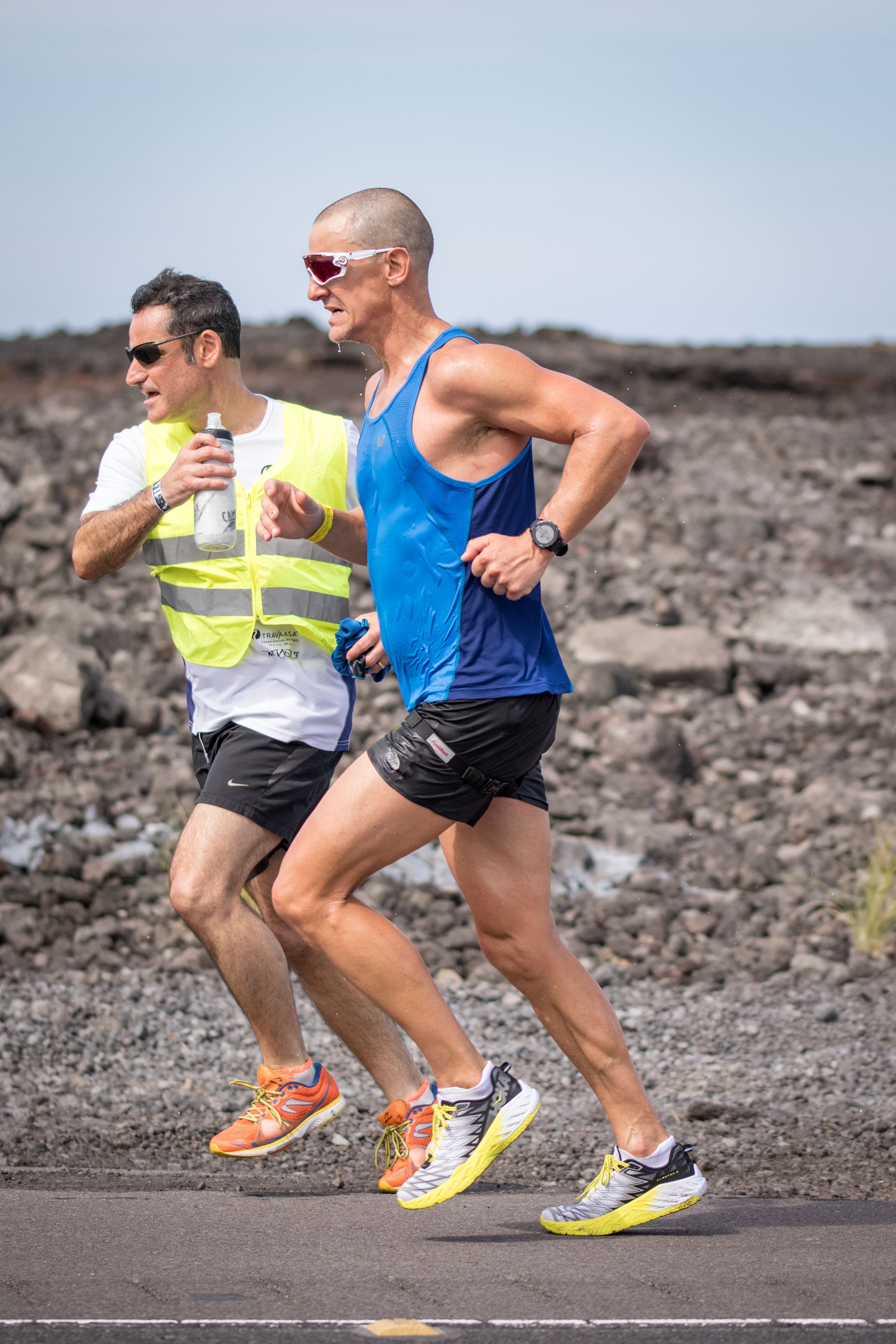 By mile 30 I'd done the math (with help from my crew on the course) and my lead was still intact. Jeremy was running fast. Really fast. But not faster than my model had predicted. He was closing maybe 4-5 minutes per hour. That meant the math was going to be close, but I should have something left at the line.
The race was being won by my model.
Around mile 38, my crew told me Jeremy had closed to about 12 minutes back. That wasn't a comfortable lead. With 14 miles to go, 12 minutes is not enough margin if he kept pushing.
This is where the decision rules in the plan kicked in. I'd pre-decided what to do in this scenario: don't try to outrun him; hold pace and trust the model. The temptation when you're being closed down is to push harder. To fight. But fighting at mile 38 of a 52-mile run, when you're already on the edge of what your body can do, doesn't end with you running faster. It ends with you bonking and Jeremy passing you.
So I held 13.5/1.5. I held 8:03/mi (well, 8:12/mi by this point. Drift was real but bounded). I trusted that 12 minutes of margin with 14 miles to go, against a guy running maybe 30 sec/mi faster than me, would still be enough.
The math: 14 miles x 30 sec = 7 minutes of additional closure. 12 - 7 = 5. I'd win by 5.
Mile 50: my crew confirmed Jeremy was about 7 minutes back. Math holding.
Mile 52: I crossed the line at 22:19:48.
Jeremy crossed at 22:25:16. Five minutes and twenty-eight seconds later.
The math worked to the second.
What the body was actually doing
For Ultraman 2017 I swallowed an ingestible core-temperature pill before Day 1 and another before Day 3. The pill (a Bodycap e-Celsius, about $200, connects to a watch via Bluetooth) logs core temp every 30 seconds. Direct physiological data on what's happening inside, not a proxy.
Across 19.4 hours of racing in 30 degrees C Hawaiian heat:
- Peak core temp: 38.1 degrees C on both Day 1 and Day 3
- Time above 38.0 degrees C: 4.2% (Day 1), 1.2% (Day 3)
- Time above 38.5 degrees C (hyperthermia threshold): 0%
For context: competitive Ironman runners in Hawaiian heat regularly cross 39.0 degrees C. 40.0 degrees C is the CNS-failure threshold that produces the death-march walk you see in Kona finish-line videos. I was running an elite thermoregulatory baseline.
The 13.5/1.5 protocol specified a walk break every 15 minutes. Every walk break was a cooling intervention. I wasn't just drinking to hydrate. I was drinking to actively cool the gut on a 15-minute cycle.
Result: Day 3 produced LESS thermal strain than Day 1 despite being longer, hotter, and a run instead of a bike. The run should have been thermally worse: less ambient airflow, more body work. Instead the cooling cadence beat the bike's natural airflow advantage.
The 13.5/1.5 protocol wasn't just a pacing protocol. It was a cooling protocol disguised as a pacing protocol. Two jobs at once. That's not an accident. It's a design choice that gets validated by direct physiological data.
What actually happened to Jeremy
Let me give Jeremy his due. He ran 6:24:17 for the Day 3 double marathon.
A 6:24 double marathon is, and I want to be clear here, elite-elite running. Pro-level running. He averaged 7:20 per mile for 52 miles after two days of full-effort racing. Most people would consider 7:20/mi for a single marathon a hard goal-race effort. Jeremy did it for 52 miles after riding 90 miles + swimming 6.2 the day before that and 171.4 miles the day before that.
He closed 35:16 on me across Day 3. He ran 30 seconds per mile faster than I did. He did, in absolute terms, the better Day 3.
He just didn't do quite enough of a better Day 3 to overcome the 40-minute lead I had going in.
I want to be honest about this. I didn't win by running faster than Jeremy on Day 3. I lost Day 3. I lost it by 35 minutes. I won the race because Day 1 and Day 2 had given me enough margin that even losing Day 3 to a guy who ran 6:24 wasn't enough to catch me.
That's not a fluke. That's a plan. The plan was: be patient on the bike days, build margin, then defend on the run with a calibrated effort that would survive Jeremy's best run.
Specifically: defend with 5 minutes of margin to spare. Not 30 minutes. Not "comfortable." Five minutes. Calibrated.
"I didn't win by running faster than Jeremy on Day 3. I lost Day 3 by 35 minutes. I won the race because the plan had already won it."
What this race actually demonstrates
This is the part I care about. Because I think every endurance athlete reading this, especially the ones who, like me, are also running companies and squeezing training around real-life schedules, has some version of "multiple races in a season, limited time, and the need to know which one matters most."
Five things this race demonstrates that I think generalize.
1. Race priority hierarchies are real, and you should use them.
Walking off Kona wasn't quitting. It was managing a portfolio. I had one A-race for the year (Ultraman). Kona was a high-prestige race I was already at, with strong fitness, and on a normal day I'd have raced it hard. But it wasn't an A-race for me, and the heat made the cost-of-pushing too high. So I walked.
2. Race plans need decision graphs, not pace targets.
A race plan that says "8:03/mile" is incomplete. A race plan that says "8:03/mile, but if X happens then Y, and if Z happens then W", that's a plan that survives contact with reality. My Ultraman 2017 plan had explicit branches for "main competitor passes," "gap closes faster than expected," and "gap stays comfortable." Each branch had a specific action. None of the actions were "decide in the moment."
3. Race-specific fitness is a different thing than CTL.
I gained 25 CTL points across the 41 days, peak to peak. That's significant. But the more important gain was race-specific. The 13.5/1.5 protocol, the long bike days at exactly Ultraman effort. CTL got me ready to be in the conversation. Race-specific fitness got me ready to execute the specific plan.
4. Opponent modeling beats opponent guessing.
I knew exactly what Jeremy Howard's race plan probably looked like. I'd watched his prior races. I'd modeled what his Day 3 would look like under various scenarios. None of this is about being smarter than him. He's a much better runner than I am. It's about making my plan account for his plan, not just my own.
5. The win margin tells you whether the plan worked.
Five minutes of margin over Jeremy Howard isn't "barely won." It's "won by the exact amount the plan was designed to produce." When the win margin matches the model, that's the plan working.
Why I'm telling you this
I'm building enza.team because I want every endurance athlete to have access to the kind of race-day judgment that elite athletes accumulate over decades of racing. That judgment isn't magic and it isn't innate. It's a specific set of habits and frameworks that can be learned and deployed.
The 41 days between Kona and Ultraman 2017 weren't an exception in my career. They were the most concentrated example of a way of working that I'd been refining for years. From my first IM (Switzerland 2011, 11:02, walking water stations in cold rain) to my sub-9 IM Texas in 2018, every race added a piece. The 41 days at the end of 2017 were when most of those pieces clicked.
If you're a serious endurance athlete who also has a real job, real kids, real life, I see you. I am you. The right answer for us isn't more training. It's better execution of the training we already do. Race priority hierarchies. Decision graphs. Opponent models. Lessons that travel from race to race instead of getting forgotten. A coaching framework that respects the limited time you have and makes every hour count.
That's enza.
If this resonates and you want to work together, start here.
This is the kind of thinking that goes into every training plan I write.